Thursday, October 16, 2008

Theory Post: A Compromise

The new issue posed for the presidential election of this year, being the Rescue bill, was a fairly non-polarized, agreeable issue between the two candidates. Both McCain and Obama supported the passage of the bill; however, Obama has a more precise plan for tackling the economy if elected than McCain's plan.

Obama's economic jumpstart plan includes the creation of jobs through organizations such as the Manufacturing Extension Partnership, tax relief for the middle class through his plan "Making Work Pay", and the protection of homeownership through his universal mortgage credit plan.
McCain's economic jumpstart plan is vague and unthoughtful. His national website only focuses on his past experience as a Senator and his past contributions as a Senator.

McCain and Obama also agree that they should stabilize Fannie Mae and Freddie Mac because they are both influential in the housing market. While both candidates agree that the passage of the Rescue bill was a good idea, but McCain has yet to inform the public on how else he is planning on revamping the economy if he is elected President


Wednesday, October 15, 2008

NATIONALIZING OF BANKS!

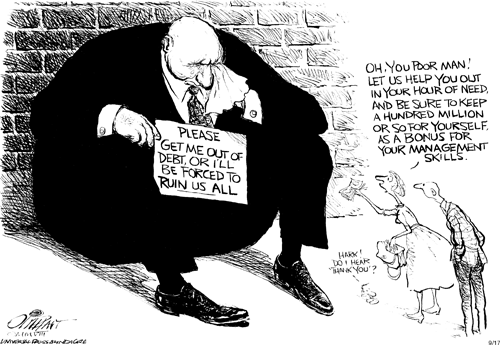
Who would have thought that the government of the United States would be so inclined to completely control the banks. Economists worry that banks need confidence to make loans to each other and to their customers. This would get money circulating in the economy. Bush followed a similar plan enacted in Britain and other European countries to buy equity in financial institutions. Bush let Europe be the ring-leader because of a fear of too much national control in the U.S. That plan includes that half of the $250 billion goes to the nine largest banks. An additional $100 billion can be authorized by the president if needed. Also, it entails that there is insurance on all deposits in non-interest banks. These moves should give the banks confidence. Bush and Paulson were against this. Fox stresses that government intervention is so great right now that the government is literally instilling $250 billion directly into the banks of America. Paulson claims that the reasoning behind this intervention is to provide businesses and consumers with access to financing.

Daniel Larison posted on his blog "Eunomia", that the government’s intervention in the economic crisis is “exacerbating the real problems in the credit markets and sapping market confidence with apocalyptic warnings.” I disagree with Larison. I agree with a response to this blog posted by jaloren. Jaloren said that there is no data to support Larison’s claim. I agree that the government’s intervention is not worsening the economic state but rather, the government assisted in the initial crisis by poor regulation.

Monday, October 13, 2008

IN-DEPTH LOOK AT THE RESCUE BILL

The Rescue bill is, in my opinion, a major determinant of our generations’ future financial lives. Now that it is unchangeable and in action, it is the appropriate time to explore the techniques and solutions it proposes to fix the economy. The bill designed a new office in the Treasury that is meant to deal solely with the financial stability of our country called the Office of Financial Stability. This office holds the power to purchase problematic assets from banks and take other necessary measures to rehabilitate the economy. However, in order to regulate the Office of Financial Stability the Rescue bill made it a requirement that the Office must initially get their financial spending approved once it surpasses the $250 billion mark. Due to the lack of regulation of Wall Street and other influencers on our economy, Congress is making it imperative that there is total regulation of all financial influencers; thus, Congress established and “Oversight Committee” that is responsible for helping and watching over the Office of Financial Stability.

Now, let’s take a look at who the Rescue bill mostly plans to affect:

1) 400,000 homeowners on the brink of losing their homes to foreclosure

2) First-time house buyers who cannot afford to put a down payment on a home

3) States and cities that will receive money to restore foreclosed homes

4) Mortgage counseling for those uninformed

5) Fannie Mae and Freddie Mac

While those who are going to profit from the bill are fortunate, some critics analyze the small amount of benefits in comparison to the large sum of money being used in this bill. John Vogel, a business professor at Dartmouth, said “We’re not getting enough for our money…it will not address the problem as fully as we would have liked.” While economists partly agree with critics’ such as Vogel’s views on the Rescue bill, experts also note that this is just a small step in the long journey to repairing our economy—this is the most we can do for now.

Before this post comes to an end today, I want to touch on the subject of the economy’s affects on YOU and YOUR student loans. Education is a very important factor in becoming a successful American, and without the aid of student loans many students are unable to graduate or even attend a university. The Senate made sure that the Rescue Bill addressed the subject of student loans when the issue surfaced on September 17, 2008. The Senate guaranteed that the Rescue bill contained a section that endeavors to provide student loans for students in the years 2009 and 2010. (THANK YOU SENATE!)

That is all for now ya’ll, but stay posted for information regarding the Rescue bill at work in our economy and the Presidential candidates’ plans to rehabilitate our economy.


Thursday, October 9, 2008

ANALYSIS POST

Now that the "Rescue" bill has been enacted, all we can do is continue being consumers in the economy and sit back and watch the effects of this plan on our economy. Since the state of our economy is so revolting, it is clear that McCain and Obama’s economic plans should be fully comprehensible for the American voters in order to make a rational vote in the fast-approaching election. Here, I am going to explore McCain’s and Obama’s extensive economic strategies to restore our failing economy.

Let’s start with Obama since his Vice President, Joe Biden, undoubtedly took the gold in last Thursday's Vice Presidential debate.

First, we’ll look at Obama’s view on the economy and how it has reached such an unprecedented low. Obama points fingers mainly at Wall Street, CEO’s and investors when asked who the culprits were behind the problem in an interview on "60 Minutes." In this interview, Obama emphasized how important it is to have a regulatory system that checks on greedy, powerful Americans.

One huge problem Americans today face is the rapidly inreasing rate of unemployment. Obama poses several solutions to the issue of unemployment in the United States, one of which is known as the Advanced Manufacturing Fund. Originating in Michigan, Obama plans to nationalize this motivation for manufacturers to create new products and jobs in order to be rewarded over $125 million. This plan sounds terrific, but Obama has yet to provide substantial evidence for how he plans to fund this.

Another aspect of Obama’s economic plan is to provide tax relief for the middle class. Obama and Biden plan to cut income taxes by $1,000 for middle class Americans. The Obama-Biden administration has stressed a lot about restoring “fairness” back into taxes; they plan to implement a program called "Making Work Pay" will completely eliminate salary taxes for 1 million Americans. Wow! If think how much money a McDonald’s employee will make per hour without having to pay taxes on their salary. Most importantly, the Obama-Biden administration has a two-part plan to jump-start the economy. One of these parts contains a $25 billion State Growth Fund to protect Americans from health, education, housing, and heating cuts. Also, to provide more jobs for Americans Obama also plans to give $25 billion in a Jobs and Growth Fund program to implement road and bridge construction—which he estimates will provide over 1 million jobs.

These programs sound terrific and very plausible; however, I am still unsure and very curious as to where Obama is planning on getting all of this money from.

Now, let’s take an in-depth look into the McCain-Palin economic plan. I’m going to be honest and say that when comparing Obama’s economic plan to McCain’s economic plan, right off the bat I notice that Obama has already formulated programs to restore the economy, while McCain’s national website mainly focuses on his past programs rather than what his plans to restore the present-day failing economy we have in our hands.

First of all, just three weeks ago McCain claimed that our economy was "strong". Was this a joke? Seriously? Gas prices have been insanely high, food prices at restaurants have increased, and the stock market was beginning to show signs of failure. Our current President Bush had even already noted the failing economy. The following Tuesday McCain began pointing fingers, which clearly indicates that there is a grave issue in our economy. McCain, like Obama, turned to Wall Street to lay blame on the economic crisis—I agree with this move. The problem that worries me with McCain is the fact that he even claimed that he was not as informed on economic issues as he probably should be. This is a scary attribute to have when helpless Americans are turning to the presidential candidates to pull us out of the economic slump that is affecting so many families.

McCain’s only program is called the the National Commission on Workplace Flexibility and Choice. McCain clearly expresses that he believes families shouldn’t sacrifice core values simply due to inflexibility in the workplace. This program only touches on the preservation of family rather than exploring ways to increase job availability in the United States. Hm...

When dealing with the prominent issue of our economy, the main focus should be on what the people want. Since the presidential candidates are fighting to be a potential representative of the constituents, I think that it is very important to research about what Americans are craving in a President.

Of the issues from the 2008 election, there is the obvious, most important concern—the bailout bill and the economy. In a national CNN/Opinion Research Corp. poll of more than 1,000 Americans, the results showed that 62% of Americans think the government should intervene with the free market system and try to fix the problems of our financial institutions. However, research shows that Americans are holding a double-standard for politicians because Americans are against the “rescue” bill. The reasoning behind their fear is the burden that the bill will have on taxpayers.

Did you watch the Presidential debate on Tuesday night? During the Presidential debate on October 7, 2008, Barack Obama and John McCain spent half of the time discussing the economy. Since the Presidential debate was set up in a Town Hall style, where the audience was full of undecided voters, McCain and Obama’s questioning was derived from the audience. Of course, the first question that was posed dealt with the financial crisis—“What are the presidential candidates planning on doing to protect retired and older citizens who are losing their incomes?” McCain and Obama, of course, responded to this question by blaming each other for supporting the corruption in the financial system.

Watch the next, and last, Presidential debate of the 2008 election on October 15, 2008! Stay tuned to my blog for more updates on the candidates’ stances on the “rescue” plan and for their own plans to rescue our economy.

Sunday, October 5, 2008

ONLY TIME WILL TELL

I am fully aware that the stock market did not completely “crash”, Tommy. But at the same time is it safe to claim that the stock market is running smoothly and efficiently today? No, the stock market is falling apart and on the road to disintegrating. I do think that there are other factors than the banking practices that contributed to our economic crisis, hence the reason I said “There are many factors that have contributed to this economic crisis.” Some factors include the loaning of mortgages that could not be reimbursed, and the decline of banks’ assets as a result of the worthless housing market. Tommy, I clearly know that Obama and McCain should focus on the economic crisis…the point to my rhetorical question at the end of my post was acknowledging the fact that Obama and McCain have NOT been focusing on the economic crisis, but rather, their campaigns. I, without a doubt, believe that they should have suspended their campaigns in order to compose a solution and to share with the public—my question was do you agree with their decision to continue prioritizing politics rather than the economy? Thank you for posting!

Revan, I do believe that the banks are primarily responsible for the economic crisis. Possessing much of the responsibilities regarding our country’s financial status, I deem the banks accountable for loaning money they did not possess and for lying to the American people. What other large factors do you think could have played a big role in the economic crisis? Thank you for posting!

Student—I love that your “name” is student. First of all, it was very thoughtful of you to recognize that Congress would most likely pass a very similar bill to the Bailout bill within the next week…because, Congress did just that this past Friday. I think that the main reason for why the public is very much against the Bailout bill is because of the idea that the government is giving one of the main contributors to the economic crisis (the banks) a huge sum of money ($700 billion) which happens to be our (the taxpayers) money. Thank you for posting!

Rinna, thank you for posting! I agree in the sense that it feels like the government is simply giving money back to the root of the problem. However, there is a time and place for government intervention with the economy and our free market system, and I believe that now, more than ever, the government needs to take immediate action because the economy is not going to fix itself for a very long time. Read my following post for further discussion on the final Bailout bill and then let me know if you are still opposed to the plan.

THE $700 BILLION BAILOUT BILL WAS ENACTED ON FRIDAY, OCTOBER 3, 2008. What a landmark day for United States politics. The House approved the bill with a 263-171 vote http://www.sfgate.com/cgi-bin/article.cgi?f=/c/a/2008/10/04/MN2113B16U.DTL. Also known as the Rescue bill (in order to gain more support), the Bailout bill is going to give the banks up to $700 billion of taxpayers’ money in order to restore lost assets due to insecure mortgages. Time is the key to solving any issue, and just like with the Bailout bill, economists are unsure how long it will take for banks to gain the confidence needed to loan money and revamp the economy. Christian Menegatti, lead analyst for economic research firm RGE Monitor, thinks that this bill is not going to completely relieve the banks of their deficits and fix the economy. Menegatti believes that after the bill is implemented the “problems are going to come back and the lack of confidence will come back” http://money.cnn.com/2008/10/04/news/economy/will_it_work/index.htm?postversion=2008100408.

Let’s take a look at the presidential candidates’ plans to jumpstart our economy.

Barack Obama voted for the passage of the Bailout bill. Obviously, Obama wants to create millions of jobs for unemployed Americans and in order to achieve this he is going to provide $25 billion in a Jobs and Growth Fund to “prevent cutbacks in road and bridge maintenance and fund school repair”—this will open up 1 million jobs for Americans. In order to protect Americans from health, education, housing and other cuts, Obama is providing $25 billion to the State Growth Fund http://www.barackobama.com/issues/economy/#jumpstart.

John McCain also voted for the passage of the Bailout bill. McCain also has a comprehensive economic plan that includes creating millions of jobs, energy security, and organizing the government’s budget. For more information regarding McCain’s economic plan you can visit his website at http://www.johnmccain.com/Issues/jobsforamerica/.

Now that the Bailout bill has been passed, we can only wait and hope for a successful outcome to revamp our economy. It was just recently reported that 159,000 people have lost their jobs. Knowing that numerous families have been kicked out of their homes, small businesses are unable to accomplish daily tasks devoid of loans, gas prices are still increasing even though there is an extreme gas shortage and much more, I believe that Congress was just in taking immediate action to repair our economy. However, only time will tell if the Rescue plan truly rescues the American people.

Thursday, October 2, 2008

VP DEBATE TONIGHT!

Everyone, watch the Vice President debate tonight at 9! It starts in 10 minutes! The Bailout bill and how they plan to deal with the problems of our failing economy will be addressed.
Thanks!

Wednesday, October 1, 2008

IN-DEPTH LOOK AT THE ECONOMIC CRISIS

It's obvious that our country's economy is falling apart. Citizens are losing their jobs, families are being stripped of their homes and belongings, food prices are skyrocketing, gas prices are absurdly high and even the search for gas has become incredibly challenging. We are living in a frightening economic situation that not even the wealthiest of Americans feel comfortable in. This past Monday, September 29, 2008, the stock market dropped 725 points which is a huge loss for our free market system as well as our economy as a whole. The Bailout plan was devised by Treasury Secretary Henry Paulson and the Bush administration; the plan encompassed "giving" $700 billion to the banks. The Bailout bill has outraged a lot of the American public because this $700 billion is being taken directly from each taxpayers' pocket and Americans don't understand why our government would ever even think about giving money back to the source of the problem of the economic crisis--the banks. There are many factors that have contributed to this economic crisis, but I think one main issue is the problem of people buying houses that they know they will ultimately foreclose, which forces theses houses to sit on the stagnant market and decrease in value. Thus, the banks held "assets", referring to these worthless houses, and while knowing this the banks continued to claim these as assets. Can we trust the banks enough to give them more money to circulate throughout our economy? Should Obama and McCain be focusing on the economic crisis or their political standings in the United States?

Followers